

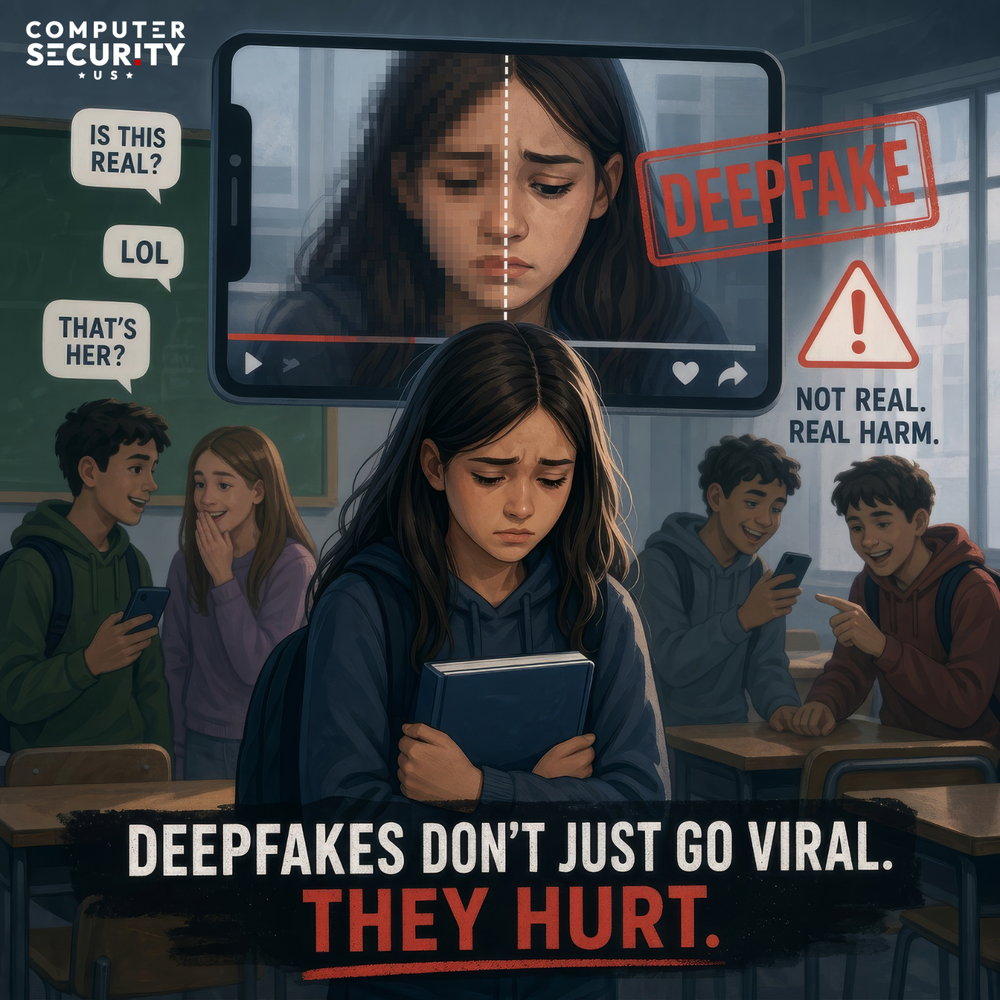
For years, the word "deepfake" lived mostly in tech headlines and film studios — a curiosity, a party trick, a special effect. That era is over. Synthetic media generated by artificial intelligence has moved out of the laboratory and into the hallways of American middle and high schools, where students are now using free, easy-to-find apps to fabricate explicit images of their classmates, impersonate authority figures, and weaponize a technology most adults still barely understand. The consequences are no longer hypothetical. They are arrests, lawsuits, traumatized teenagers, and panicked parents demanding that lawmakers act.
School districts from Virginia to Texas to Pennsylvania are scrambling to write discipline policies for a problem that did not exist in any meaningful form just a few years ago. Law enforcement agencies are making their first-ever deepfake arrests. And victims — overwhelmingly teenage girls — are left to live with images that, in their own words, never truly go away. This is the rise of the deepfake in schools, and the serious consequences it brings deserve a clear-eyed look.
What Is a Deep Fake?
Before unpacking the damage, it helps to answer the foundational question: what is a deep fake? A deepfake is a synthetic image, video, or audio clip that appears authentic but has been created or manipulated by artificial intelligence. The term is a blend of "deep learning" — a branch of machine learning that uses layered neural networks to mimic how the human brain processes information — and the word "fake." The University of Virginia's information security team maintains an excellent primer on exactly what is a deep fake and how the underlying deep-learning models actually work, written for both lay readers and the technically inclined.
It is worth noting that the technology itself is not inherently malicious. Deepfake techniques have legitimate uses — recreating an actor's performance in film, building interactive educational content, restoring damaged audio, or generating accessibility tools. The same capability that lets a studio de-age a performer, however, lets a teenager fabricate a humiliating image of a classmate. The technology is neutral; the intent behind it is not. That dual-use nature is part of what makes deepfakes so difficult to regulate without sweeping up legitimate creativity in the process.
In practical terms, a deepfake takes a real person's face, voice, or body and grafts it onto fabricated content. Early deepfakes were easy to spot: extra fingers, mismatched shadows, robotic-sounding speech, eyes that did not blink. Those tells are vanishing fast. The models improve every month, and the apps that run them have become so accessible that a teenager with a smartphone can produce a convincing fake in seconds. That collapse in the skill and cost required to create synthetic media is precisely why the problem has exploded inside schools, where the targets — and often the perpetrators — are minors.
Why Schools Have Become Ground Zero
Schools concentrate exactly the conditions deepfakes exploit: large numbers of young people, abundant photographs shared freely on social media, immature judgment about consequences, and social dynamics that reward cruelty with attention. The result is a wave of incidents that has caught administrators flat-footed.
In Northern Virginia, the issue has grown serious enough that the Fairfax County School Board began weighing a formal discipline policy specifically for students who create deepfake intimate images of their peers. As NBC Washington reported, the proposed policy would require a Title IX review, parental notification, a mandatory intervention lesson, a suspension of up to five days, and referrals to both the division superintendent and law enforcement. School board members described the trend bluntly as something they cannot tolerate in their communities. Notably, the policy would even reach conduct that happens off campus if it causes a disruption during the school day — an acknowledgment that the line between "school" and "not school" has effectively dissolved in a world of always-on connectivity.
The Fairfax conversation did not emerge in a vacuum. Several districts across the Washington, D.C., region reported similar incidents involving local students. One woman featured in the coverage described opening her Instagram to find a stranger had stolen her childhood modeling photos and used AI to generate nude images of her. Police could not trace the perpetrator, who had hidden behind a VPN, and the case was never solved. Her description of the experience as shameful and impossible to forget captures the lasting psychological weight these images carry, even when — especially when — they are fake.
Hundreds of miles away in East Texas, Jasper County made its first-ever deepfake arrest. According to KTRE, a 17-year-old Buna ISD student was charged as an adult after admitting he created an AI-generated nude image of a classmate and posted it on Snapchat. The post was visible for only a few minutes before it was taken down, but the local sheriff was clear that the damage was already done. He warned that this first case is unlikely to be the last and has begun training his deputies on AI-related dangers while planning outreach to schools. A district attorney quoted in the same report emphasized that Texas law has caught up with the technology: taking someone's likeness and turning it into explicit synthetic content is a crime, with penalties ranging from probation to incarceration.
In Pennsylvania, the fallout reached the governor's office. As GovTech reported, parents of Radnor High School students victimized by AI deepfakes joined a roundtable with Gov. Josh Shapiro and the state attorney general to demand statewide standards. Their frustration was aimed not only at the classmate who created the images but at a school response they found dismissive — one parent said the families felt more victimized by the school than by the student who made the video. The parents asked for better training for students and faculty, real accountability for offenders, and clear resources for families who suddenly find themselves with nowhere to turn. Similar anger surfaced in the nearby Council Rock School District, where parents said nearly a dozen girls were targeted and accused the district of waiting days to involve police and extending more deference to the accused boys than to the victims.
Beyond the Classroom: When Deepfakes Trigger Real-World Crises
The school cases are the most emotionally charged, but they are only one face of the threat. Deepfakes are increasingly colliding with the physical world in ways that endanger public safety. In Florida, a 22-year-old man was arrested after allegedly posting an AI-generated video showing men breaking into a Seminole County deputy's patrol vehicle. As FOX 35 Orlando reported, the fabricated clip was convincing enough to prompt a real armed response — a deputy ran into a parking lot with his hand on his weapon, reacting to a crime that had never occurred. He now faces a felony charge and two misdemeanors.
A security expert interviewed in that report drove home the core problem: artificial intelligence has made this kind of deception trivially easy. He demonstrated live how quickly he could capture a reporter's photo and swap his own face onto hers in real time, and he warned that hunting for visual glitches is no longer a reliable defense because the fakes keep improving. His advice was simple and sobering — slow down, trust less, and verify the origin of what you see. A former detective in the same coverage imagined a darker version of the story: what if an innocent bystander had been standing near that patrol car when the armed deputy arrived, convinced a crime was in progress? The potential for a deepfake to cause not just embarrassment but physical harm or a deadly misunderstanding is very real.
The Human Toll and the Serious Consequences
It is tempting to file deepfakes under "technology problems," but the consequences are profoundly human. For the teenage girls at the center of most school cases, a fabricated image circulating among classmates is not an abstraction — it is a violation that follows them through hallways, into friendships, and onto every platform where the image might resurface. Victims describe a persistent fear that the content will reappear, that it will surface during a job search or a college application, that it will be used to harass them again years later. The fact that the images are fake offers little comfort when peers, and sometimes strangers, react as if they are real.
Compounding the harm is the speed and reach of distribution. A fabricated image can be created in seconds, shared to a group chat in seconds more, and screenshotted and re-uploaded faster than any platform can remove it. Even when the original post is deleted within minutes — as happened in the Jasper County case — copies may already exist on devices beyond anyone's control. Unlike a rumor that fades, a deepfake is a durable file that can be stored, traded, and resurfaced indefinitely, which is why victims describe the fear as something that never fully ends.
The harm radiates outward. Families are thrust into legal and emotional crises with no roadmap. Schools face liability, reputational damage, and the impossible task of policing conduct that often originates on personal devices outside their walls. Communities lose a shared sense of trust in what they see and hear — a corrosion that researchers have begun calling the "liar's dividend," where the mere existence of deepfakes lets genuine wrongdoers dismiss authentic evidence as fabricated. When anything can be faked, everything becomes deniable.
There is also a chilling equality to the threat. A deepfake does not require its victim to have done anything wrong, posted anything compromising, or made any mistake. A single ordinary photo scraped from a yearbook, a sports team page, or a social media profile is enough raw material. That means essentially every student — and every teacher, parent, and public official — is a potential target.
The Legal Landscape Is Racing to Catch Up
Lawmakers and prosecutors are responding, but unevenly. In Virginia, creating obscene deepfake images is currently a Class 1 misdemeanor, punishable by up to twelve months in jail and a fine of up to $2,500. Texas, as the Jasper County case showed, has explicitly criminalized turning a person's likeness into explicit synthetic content. In Florida, officials and law enforcement experts are openly calling for stiffer penalties, arguing that using a deepfake with intent to deceive deserves to be charged as a felony rather than treated as a simple false report.
At the policy level, the picture is a patchwork. Some districts route deepfake incidents through existing bullying and harassment codes; others are drafting bespoke policies; many have nothing specific at all. The Pennsylvania roundtable highlighted the central gap: having a policy on paper means little if it is not enforced and if offenders are not held accountable. The governor there acknowledged a hole in the state's approach and pledged to direct the education department to address it. The broader lesson is that technology has outpaced both the law and institutional readiness, and the people caught in that gap are children.
One recurring theme across every jurisdiction is the call for education and training. Sheriffs want to brief deputies and visit schools. Parents want curriculum for students, faculty, and families alike. Security experts insist that technical controls, sound policy, and clear law must work together — no single fix is sufficient. That consensus points toward the most actionable response available right now: building genuine awareness before a crisis hits.
What Parents, Schools, and Students Can Do
Waiting for perfect legislation is not a strategy. There are concrete steps families and institutions can take today to reduce both the likelihood and the impact of a deepfake incident.
Start the conversation early and without shame. Many students who create deepfakes genuinely do not grasp that they are committing a serious — sometimes felony-level — offense with a real victim. Honest, age-appropriate discussions about consent, digital permanence, and legal consequences can prevent a moment of poor judgment from becoming a life-altering arrest. Equally, victims need to know they will be supported, not blamed, so they come forward quickly.
Teach verification as a default habit. The advice from security professionals applies to everyone: slow down, distrust sensational content, and check the source before reacting or resharing. A culture that pauses to verify is far more resilient than one trained only to look for telltale glitches that newer models no longer produce.
Know the reporting path in advance. One of the loudest complaints from victims' families is that no one knew who to call. Schools should publish a clear protocol — who handles a report, when police and Title IX coordinators are involved, and what support victims receive — and communicate it to parents before an incident occurs, not in the chaotic aftermath.
Limit the raw material where reasonable. Deepfakes need source images. Reviewing the privacy settings on social accounts and being thoughtful about what photos are public will not eliminate the risk, but it reduces the easy pickings.
Invest in real security awareness training. Schools, businesses, and organizations of every size benefit when their people understand modern AI threats — not as a one-time assembly, but as ongoing, practical education. Understanding how deepfakes are made, why they work, and how to respond is the closest thing there is to a vaccine against them.
A Threat to Cybersecurity — and to Humanity
Carl B. Johnson, keynote speaker, instructor and founder of Cleared Systems, frames the stakes in terms that go well beyond technology:
"Deepfakes are one of the most serious threats to not only cybersecurity, but to humanity itself. Humans all share the same programming, and like a computer, that programming can be hacked and manipulated. Deepfakes do exactly that."
It is a fitting way to understand the moment. Traditional cybersecurity has always concerned itself with protecting machines and data. Deepfakes attack something deeper: our shared ability to trust our own eyes and ears, the basic operating system of human society. When a forged image can ruin a teenager's life, trigger an armed police response, or swing public opinion, the target is not really the computer — it is the human mind, and the trust that binds communities together.
The Bottom Line
Deepfakes in schools are not a distant or theoretical concern. They are here now, generating real arrests, real lawsuits, and real harm to real young people across the country. The technology will only get better and more accessible, which means the volume of incidents is far more likely to climb than to fall. The encouraging news is that the most effective defense is also the most attainable: informed people. Laws will tighten and detection tools will improve, but awareness, education, and a habit of verification remain the front line.
If you want to understand the foundations of this threat, start with the basics of what is a deep fake, then make security awareness a priority in your home, your school, or your organization. The cost of preparation is a few hours of training. The cost of ignorance, as these cases make painfully clear, can be far higher.